
All mice squeak, but only some sing. Scotinomys teguina, aka Alston’s singing mice, hail from the cloud forests of Costa Rica. More than 2,000 miles north, Cold Spring Harbor Laboratory (CSHL) neuroscientists study these musically gifted mammals to better understand the evolutionary origins of vocal communication. Their research could also tell us something about strokes, autism, and other disorders affecting speech.
While most of us are familiar with mouse squeaks, “they have a whole other communications system called ultrasonic vocalizations (USVs),” says CSHL Assistant Professor Arkarup Banerjee. USVs are so high-pitched and soft we can only hear them with special devices. That’s not the case for the “songs” of Alston’s singing mice. Most of us can hear them clearly.
Notably, singing mice can also communicate via USVs. It’s thought that they sing to project across great distances—an important skill for living among the clouds. But just how are these communications physically produced? How do singing mice’s brains, which are comparable to those of ordinary lab mice, enable such complex behavior? Banerjee’s latest study, published in Current Biology, addresses both questions.
PARId stands for “partial acoustic isolation reveals identity.” In the PARId tests shown here, a male and a female mouse are each placed in one of two enclosures (top left). Their movements and relative positions are digitally plotted (top right). Vocalizations are recorded in each enclosure and mapped via spectrograms (bottom).
First, Banerjee and his team developed a behavioral test called PARId to characterize the different sounds that singing mice can make. The tests confirmed Alston’s mice use long, loud, rhythmic songs to communicate from afar and USVs for close talking. Banerjee lab postdoc Cliff Harpole then gave the mice helium to see if they produced songs by vibrating their vocal cords or blowing air. The “party trick” offered surprising results, Banerjee says:
“For both USVs and songs, the pitch went up. So, we know for sure that they’re produced by a whistle mechanism.”
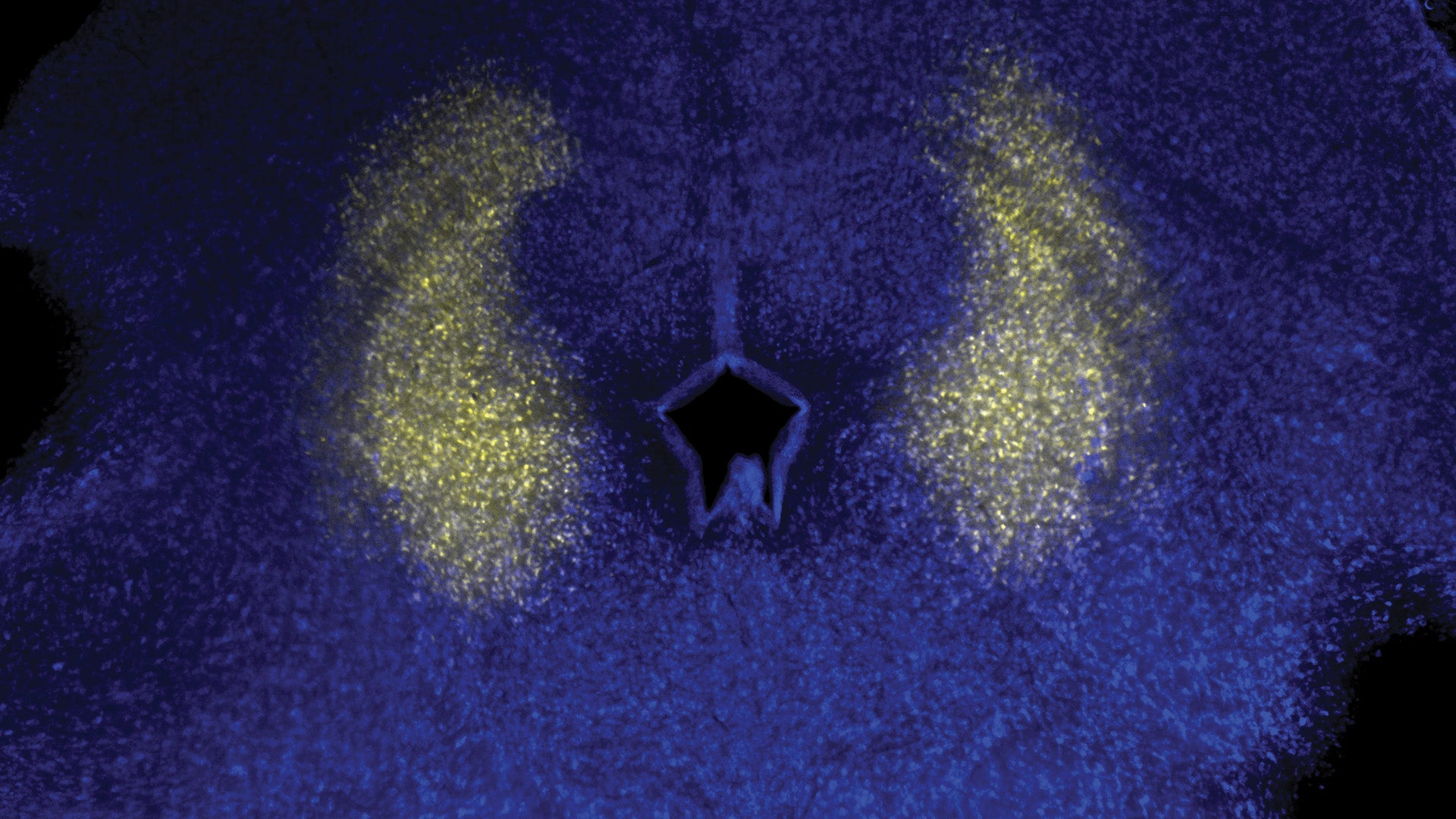
Next, CSHL grad student Xiaoyue Mike Zheng used special viruses to target certain areas of the mice’s brains. These tests revealed something arguably even more surprising. It turns out Alston’s mice use the same brain region for singing and USVs. And it’s the same region ordinary lab mice use for daily communications. The finding offers an important clue in the mystery of how mammals’ brains have evolved to enable complex behaviors like social interactions. Banerjee explains:
“This is one of the foundational studies from the lab trying to get into this new domain of how behaviors evolve. We have found what is common. So now the hunt is on for what’s different.”
In time, the Banerjee lab’s research on vocal communication could have implications for people with profound autism or stroke-induced aphasia. Their findings may even help engineers make AI better at recognizing specific words and noises. Now, how does that sound?
Written by: Samuel Diamond, Senior Communications Strategist | diamond@cshl.edu | 516-367-5055
Funding
National Institutes of Health BRAIN Initiative, Searle Scholars Program, Pershing Square Foundation Innovator Fund, Esther A. & Joseph Klingenstein Fund, Cold Spring Harbor Laboratory, International Society for Neuroethology Konishi Research Award, George A. and Marjorie H. Anderson Fellowship
Citation
Zheng, X., et al., “Vocal repertoire expansion in singing mice by co-opting a conserved midbrain circuit node”, Current Biology, November 17, 2025. DOI: 10.1016/j.cub.2025.10.036
Core Facilites
 “The Animal Shared Resource houses and cares for the animals essential for scientific research. Our staff perform all aspects of animal husbandry, ensure humane care, and assist researchers with highly technical procedures and protocol design and development.” — Animal Facility Director and Attending Veterinarian Rachel Rubino, DVM
Principal Investigator

Arkarup Banerjee
Assistant Professor
Ph.D., CSHL School of Biological Sciences, 2016